Dukhoon and Bakhoor in Oman
Article Summary: Dukhoon and bakhoor are two words for the same thing, and anyone who draws a hard technical line between them is inventing it. The difference is in usage, not product: bakhoor is the classical word tied historically to frankincense, dukhoon is the everyday Gulf word that has come to mean the modern compounded blends. Below is what MOJ actually sells to burn in Oman, and what sets Dhofari luban apart from everything else on the burner.
- Omani luban is the resin of Boswellia sacra in Dhofar; its four trade grades are Hojari, then Najdi, then Shazri, then Shaabi, and the order is set by how far the tree stands from the khareef rains.
- Omani frankincense was registered as an international geographical indication at the World Intellectual Property Organization on 20 April 2026, the first such registration in the Gulf.
- UNESCO inscribed the Land of Frankincense in 2000 as the Frankincense Trail, then renamed it by committee decision at its 29th session in 2005.
- Oud is not Omani. The Aquilaria tree is native to South and Southeast Asia, so every oud in Oman is imported, while luban is the scent that belongs to this land.
- MOJ Dukhoon Khalifa and Dukhoon Mubakhar Al Hamra are OMR 2.800 each; Oud Sticks start at OMR 2.800. All three were available on October 21, 2026.
| Product | Form | How to use | Price |
|---|---|---|---|
| Dukhoon Khalifa | Dukhoon for burning | Charcoal or electric burner | OMR 2.800 |
| Dukhoon Mubakhar Al Hamra | Dukhoon for burning | Charcoal or electric burner | OMR 2.800 |
| Oud Sticks | Incense sticks | Lit at the tip in a holder | From OMR 2.800 |
Dukhoon and bakhoor: are they the same thing?
Yes, and the answer is clearer than what you read online suggests. Al Arab, in its report on the bakhoor trade in Oman, says of the two words that they carry and denote the same meaning in both term and sense. Dubai Culture and Arts Authority uses dukhoon alone as the name of the industry in its official releases and never mentions bakhoor at all. There is no scholarly source that separates the two on technical grounds.
What you will find in online shops is three contradictory answers: one store says bakhoor is natural oud wood and dukhoon is the manufactured pellet, another says bakhoor is the broad category and dukhoon a blend for occasions, a third defines bakhoor and never defines dukhoon. These are not documented definitions but trade descriptions that contradict one another. The honest position is that the two words are synonyms, with a difference of association: bakhoor is the classical word tied historically to frankincense, dukhoon the everyday word that has come to mean compounded blends.
Two other words deserve a line because they are trade terms, not official ones. Maamoul literally means "made" and is used in the market for the kneaded or moulded form. Muattar literally means "perfumed" and is used for wood chips soaked in fragrance oils. The literal meaning of each is a truer guide than any shop definition.
As for oud, it is neither a substitute for bakhoor nor a synonym, but a raw material: resinous wood that can be burned alone or go into a bakhoor blend as one ingredient. Confusing the two is the commonest mistake in this subject. What MOJ sells to burn is in the bakhoor collection.
The best dukhoon and bakhoor from MOJ
1. Dukhoon Khalifa
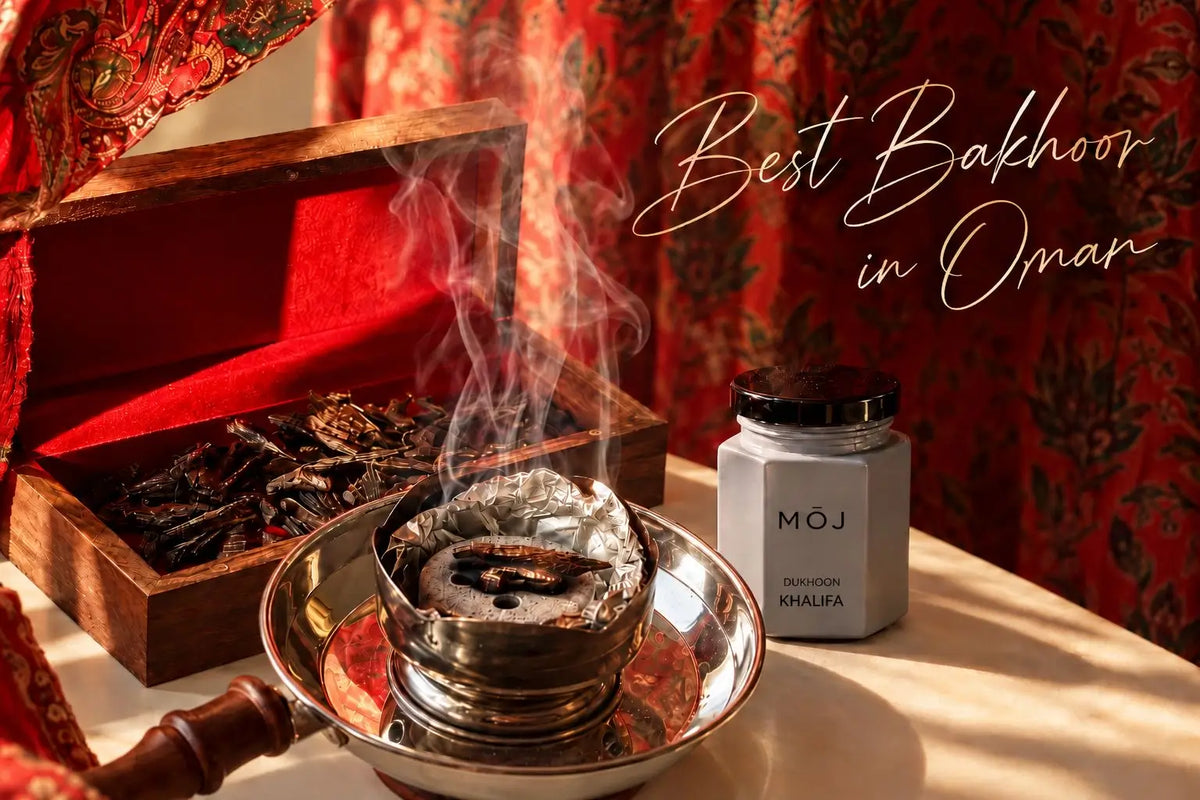
A dukhoon with an oriental woody blend: rich woody notes with a smoky touch of oud and a soft musky depth. A small amount goes on charcoal or in an electric burner. It is made for the home, the majlis and the office, and it costs OMR 2.800.

2. Dukhoon Mubakhar Al Hamra
The darker sibling of Dukhoon Khalifa: the woody notes go deeper and the smoky oud is more present, over a rich musky base. Same use, a small amount on charcoal or in an electric burner, and the same price, OMR 2.800. The difference between the two is one of degree, not kind; if you want the quieter one for daily use, Khalifa, and the heavier one for occasions, Al Hamra.

3. Oud Sticks
These are not dukhoon but incense sticks, lit at the tip and stood in a holder, so they need neither charcoal nor a burner. They are the practical choice for anyone who wants the smell of oud at home without the whole charcoal ritual, in three sizes from OMR 2.800. The rest of the home fragrances are in the home fragrance collection.

Omani luban: why it is different
Luban is the resin of Boswellia sacra, and its home is Dhofar. Its trade grades run four deep, from highest to lowest: Hojari, then Najdi, then Shazri, then Shaabi. What sets the order is not price or market but rain: Hojari comes from the dry eastern wadis beyond the reach of the khareef, Shaabi from the areas most exposed to it. Studies published in 2025 and 2026 measure the difference: Hojari is paler, more saturated in colour and lower in moisture; Shaabi comes in larger lumps, holds more moisture and is darker and softer. The most prized of all of it is the pale tear with a faint tint of green.
Harvest runs from April to June, before the khareef arrives, with a tool called the manqaf, and the cuts it leaves are called tawaqee. According to an Omani study published in 2025, Oman produces between seventy and a hundred tonnes a year and consumes forty to fifty of them at home. That is, more than half of Omani frankincense is burned in Omani houses rather than exported, and that is the fact that ties luban to the subject of this article. Our guide to Omani luban covers the resin on its own.
UNESCO inscribed the Land of Frankincense in 2000, with its four components Wadi Dawkah, Shisr, Khor Rori and Al-Baleed. The detail missing from most of what is written is that the site was first inscribed as the Frankincense Trail and renamed the Land of Frankincense by decision of the World Heritage Committee at its 29th session in 2005. On 20 April 2026 the Ministry of Commerce, Industry and Investment Promotion registered Omani frankincense as an international geographical indication at the World Intellectual Property Organization, the first registration of its kind in the Gulf. Amouage, for its part, signed an agreement with the Ministry of Heritage and Tourism in 2022 to develop and protect Wadi Dawkah, though sources differ on the number of its trees, from hundreds to over a thousand.
Oud in Oman is imported, not local
This is worth saying plainly. The Aquilaria tree, from which oud is taken, is native to South and Southeast Asia: India, the Philippines, Malaysia, southern China, Indonesia, Vietnam, Cambodia, Laos and Thailand. It does not grow in the Arabian Peninsula. Every oud in Oman is imported; luban is the scent that belongs to this land and oud is its adopted one. The oud you wear rather than burn is covered in our guide to the best oud perfumes in Oman.
Oud is expensive because the resin forms in the tree only as a response to stress, a fungal infection, an insect bore or a wound, and only in about seven to ten percent of trees. All Aquilaria species have been listed in Appendix II of CITES since 2005, with Aquilaria malaccensis listed earlier in 1995. Appendix II means regulated trade under permit, not a ban, so it is wrong to say oud is prohibited.
Bakhoor in the Omani home
Here is a number worth pausing on. In a peer-reviewed Omani ethnographic study published in 2026, with two hundred and eighty participants across six wilayats of North Al Batinah, 96.5 percent said they burn frankincense. Fumigation accompanies the forty days after a birth, circumcision, marriage, death and moving into a new house. And 82.1 percent reported that they consider luban useful against the evil eye, which is what the participants reported believing, not what the study proves about any effect. It should be noted that the sample is North Al Batinah, not all of Oman.
Mabkhara is the general word, but the Omani word, and in Dhofar especially, is the majmar: the cube-shaped clay burner made in Salalah, Mirbat and Taqah, and the pottery craft of Dhofar was historically women's work. The cube form of the majmar runs unbroken from antiquity to the workshops of Salalah today, as documented in academic studies of Gulf anthropology. Saying majmar instead of mabkhara is the fastest way to tell an Omani reader you know what you are talking about. If you are new to buying perfume in Oman, our guide to where to buy the best perfumes in Oman covers the counters.
Souq Al Haffa in Salalah, also called Souq Al Husn, is the known market for luban, bakhoor and perfume, and its busiest season is the khareef.
How to use bakhoor, and ventilation
We will not give you numbers we do not have. The burn times and piece counts that circulate come from shops, and they contradict one another. But two things are agreed on and worth saying.
First, under-lit charcoal is the main cause of bad-smelling bakhoor. Wait until the charcoal is grey at every edge rather than glowing red. A sharp chemical smell is the sign you rushed. Second, too much bakhoor in a closed room is the commonest beginner mistake; a little is enough.
Ventilation is a health matter, not a cosmetic one, and honesty requires saying so. Two peer-reviewed studies, one published in 2021 and the other in 2026, measured the emissions from burning incense and found fine particles and gases including benzene and formaldehyde at levels that in laboratory testing exceeded the World Health Organization's indoor guidelines, and the recommendation of both studies was more ventilation and shorter, less frequent burning. It should be noted that both studies tested incense sticks, cones and continuous burning in places of worship, not Gulf bakhoor on charcoal in a majmar, and we found no study that measured the latter specifically. The practical conclusion is simple: open a window.